The short answer
Most high rise window cleaning uses one of four methods. Water-fed poles clean from the ground up to about 70ft. Cherry pickers lift a cleaner to the glass where there’s room to set one up. Rope access technicians abseil down the face of taller or awkward buildings. And some towers have their own cradle, or building maintenance unit. The right method depends on the height, the ground around the building and what’s on the roof.
If you manage an office block, an apartment building or a site with tall glazing, the method your window cleaner uses affects the price, the disruption on the day and, above all, safety. This guide explains how high rise window cleaning is done, when each method makes sense, and what to check before anyone works at height on your building.
What counts as high rise?
For window cleaning, “high rise” simply means glass that can’t be cleaned safely from the ground or a short ladder. In practice that’s anything above three or four storeys, plus atriums, glazed stairwells and tall shop and showroom frontages at any height.
The law sets the order in which methods should be considered. Under the Work at Height Regulations 2005, work at height should be avoided where it reasonably can be, and where it can’t, the safest suitable equipment should be used. That’s why cleaning from the ground always comes first.
The four methods of high rise window cleaning
1. Water-fed poles, from the ground
A water-fed pole carries purified water up to a soft brush, so the cleaner scrubs and rinses the glass while standing on the ground. Our poles reach 70ft, which covers most buildings up to five or six storeys, depending on the floor heights. There’s no work at height at all, so it’s the safest and usually the cheapest option. How water-fed pole cleaning works.
2. Cherry pickers (MEWPs)
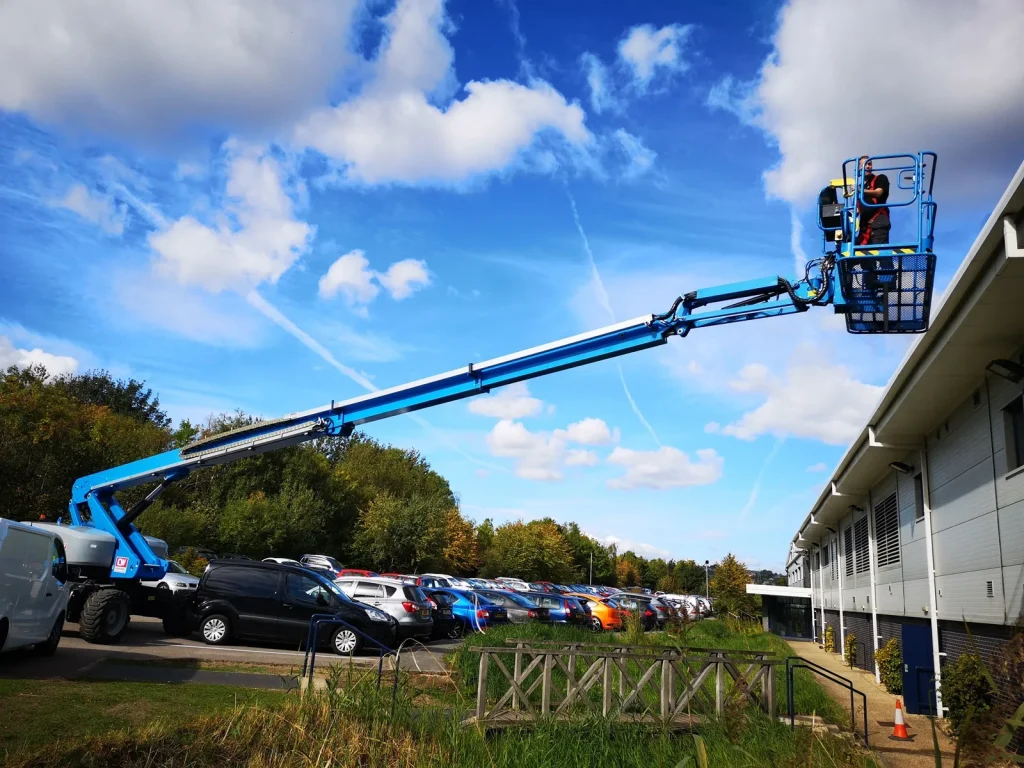
A cherry picker, or mobile elevating work platform (MEWP), lifts the cleaner in a basket to glass beyond a pole’s reach. It’s a good choice for mid-height buildings, high-level factory glazing and roofline glass, as long as there’s firm, level ground to set up on. It can need a pavement licence or traffic management near roads, and the operators should hold an IPAF licence.
3. Rope access
Rope access technicians fix ropes to tested anchor points on the roof and descend the face of the building, cleaning the glass as they go. Each technician works on two independent ropes, a working line and a backup, with a rescue plan in place. Rope access suits tall buildings and anywhere a cherry picker can’t be set up: over car parks, roads, landscaping or busy entrances. There’s no heavy machinery and very little footprint on the ground. Rope access window cleaning.
4. Cradles and building maintenance units
Some tall buildings have a permanent cradle, or building maintenance unit (BMU), that runs along the roof and lowers a platform down the face. It belongs to the building, so it has to be maintained, and under LOLER equipment that lifts people needs a thorough examination at least every six months. If your building has one, ask your window cleaner whether they’re trained to use it, or whether rope access would be simpler.
Which method suits your building?
| Method | Best for | Needs | Watch out for |
|---|---|---|---|
| Water-fed pole | Most buildings up to about 70ft | Safe ground access around the building | Very tall or recessed glass |
| Cherry picker | Mid-height glass, rooflines, factory glazing | Firm, level ground and room to set up | Permits near roads; soft ground |
| Rope access | Tall buildings, atriums, awkward access | Tested roof anchor points | Anchor test certificates; high winds |
| Cradle or BMU | Towers that have one fitted | A maintained, examined unit | Examination records; trained users |
Many buildings need more than one method. A typical office block might have its lower floors cleaned by pole and the upper floors or an atrium by rope access, on the same visit. A good contractor will survey the building and suggest the mix that’s safest and best value, rather than defaulting to the one piece of kit they own.
What affects the cost of high rise window cleaning?
- Height and method: pole work is quickest; cherry pickers add hire costs; rope access needs more planning but no machinery.
- Access on the ground: road closures, pavement licences and car park space all add time and cost.
- The roof: rope access needs suitable anchor points. If they’re missing or out of test, that has to be solved first.
- Frequency: how often the high-level glass needs cleaning. It often needs cleaning less often than ground-floor glass. How often should commercial windows be cleaned?
What affects the price of commercial window cleaning.
Before anyone works at height on your building, ask
- Which method will you use for each part of the building, and why?
- Can we see your risk assessment and method statement (RAMS) for our site?
- What training do your operators hold: IPAF for cherry pickers, and which rope access certification for rope work?
- What is your rescue plan if someone is stuck at height?
- For rope access: have our roof anchor points been tested in the last 12 months, and can we see the certificate?
- Can we see your public liability and employers’ liability insurance certificates?
Roof anchors should be inspected at least once a year, in line with BS 7883, and it’s the building owner’s job to keep the test certificates. If you’re not sure whether yours are in date, a rope access contractor will check before starting. What safety paperwork to ask for.
How we clean high-rise windows
We clean most commercial glass from the ground with water-fed poles, up to 70ft, with no ladders and no chemicals. We only use a ladder when there’s no safer way, and never above 20 feet. Are ladders banned for window cleaners? Above pole height we use cherry pickers or certified rope access technicians, and we plan the job with you around your building’s hours, tenants and neighbours.
Every quote comes with our insurance certificates, and once you’ve accepted, we prepare a free risk assessment and method statement for your site. We clean offices, apartment blocks, schools and industrial sites across Sheffield, Rotherham, Doncaster and Barnsley. Get a quote.
Questions
How are high-rise windows cleaned?
With water-fed poles from the ground up to about 70ft, then cherry pickers, rope access or a building’s own cradle for anything higher. The right method depends on the height, the ground around the building and the roof.
How high can a water-fed pole reach?
Our poles reach 70ft from the ground, which covers most buildings up to five or six storeys, depending on the floor heights.
Is rope access safer than a cherry picker?
Both are safe when done properly by trained people. Rope access is often the better choice where a cherry picker can’t be set up safely, such as over roads or soft ground, or where the building is too tall.
Who is responsible for roof anchor points?
The building owner or managing agent. Anchors should be inspected at least once a year, and the contractor should check the test certificate before starting.
Can you clean high-rise windows in the rain?
Often, yes, but never in high winds, thunder or lightning, which matter even more at height. Do window cleaners work in the rain?