The short answer
Before a window cleaner starts on your site, ask for four things: a window cleaning risk assessment and method statement (RAMS) written for your building, copies of their public liability and employers’ liability insurance certificates, proof their operators are trained for the equipment they’ll use, such as IPAF for cherry pickers, and confirmation their staff are DBS-checked if your site needs it. A professional company will have all of it ready, and won’t mind you asking.
A window cleaning risk assessment isn’t just paperwork for the contractor’s files. If you manage an office, a school, a block of flats or an industrial site, you have a part to play in keeping the work safe, and the documents your window cleaner gives you are how you show you’ve checked. This guide explains what to ask for, what good looks like, and the warning signs.
Why the person hiring needs the paperwork
Window cleaning usually means working at height, often above staff, customers or residents. The law puts duties on more than just the window cleaner:
- The Management of Health and Safety at Work Regulations 1999 require every employer to assess the risks their work creates, including to people who aren’t their employees. Employers sharing a workplace also have to co-operate, co-ordinate their safety measures and tell each other about the risks.
- The Work at Height Regulations 2005 apply to work by anyone under your control, to the extent of that control. If you decide when, where and how the work happens on your site, some of that responsibility is yours.
The HSE’s guidance for window cleaning says the contractor should discuss the work with the client and agree a co-ordinated approach. In practice, that means you share what you know about the site, and the contractor gives you a plan showing how they’ll do the job safely. HSE: working at height whilst window cleaning.
What a window cleaning risk assessment should cover
A risk assessment identifies what could go wrong and what will be done to prevent it. A method statement sets out, step by step, how the job will be done. Together they’re known as RAMS. For window cleaning, a good set should cover:
- Height and access: how each elevation will be reached, and why that method was chosen. Water-fed poles from the ground should come first wherever they can reach.
- The people below: how staff, visitors, pupils or residents will be kept clear, with cones, barriers or timing around busy periods.
- Ground conditions: slopes, soft ground and uneven surfaces, especially where a ladder or cherry picker will stand.
- Water run-off: how wet paths and entrances will be managed, and what happens in freezing weather.
- Weather: when work stops, such as in high winds.
- Hazards on your site: overhead power lines, fragile roofs and rooflights, vehicle routes and loading bays.
- Equipment: what will be used, and how it’s checked before use.
- Emergencies: what happens if someone is hurt or stranded at height, agreed before the work starts.
How to spot a generic RAMS
A copy-and-paste document is a warning sign. Check that the RAMS:
- Names your building and address, not just “the client’s premises”.
- Mentions the features of your site, such as your car park, entrances, rooflights or the elevations that need a cherry picker.
- Matches the method the cleaner told you they’d use.
- Is dated and signed, and is reviewed if anything on the site changes.
An employer with five or more employees must record the significant findings of their risk assessment. A method statement isn’t a legal requirement in itself, but for work at height on a commercial site it’s standard practice, and most facilities teams and managing agents will expect one.
Insurance certificates
Ask for copies of the certificates, not just a verbal assurance, and check the dates, the company name and the limits.
- Public liability insurance covers injury to other people and damage to property caused by the work, such as a pole through a window or a visitor slipping on run-off. It isn’t a legal requirement, but you shouldn’t let a contractor on site without it.
- Employers’ liability insurance is a legal requirement for almost any company with employees. It must cover at least £5 million, and a company can be fined £2,500 for every day it isn’t properly insured. The only common exemption is a business that employs only close family members. GOV.UK: employers’ liability insurance.
- Products liability is often included alongside public liability, and is worth checking if the contractor supplies or uses products on your site.
Check the cover suits the work. If the job involves cherry pickers or rope access, ask whether the policy covers those methods, and if any part of the work will be done by a partner or subcontractor, ask for their insurance too.
Training and competence
The HSE says everyone working at height must have the right skills, knowledge and experience. Ask what training the operators on your site have had for the equipment they’ll use:
- Water-fed poles: training in using and handling long poles safely, including around overhead cables.
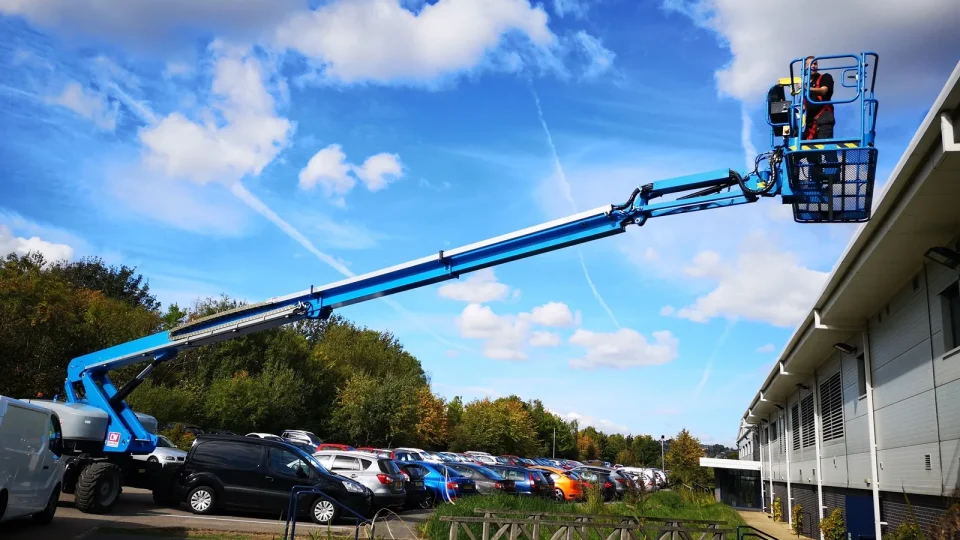
- Cherry pickers (MEWPs): the IPAF PAL card is the recognised proof that an operator is trained on that type of platform. Ask to see it, and check it covers the category of machine being used.
- Ladders: training in safe ladder use, and a clear reason why a ladder is needed at all. Are ladders banned for window cleaners?
- Rope access: specialist work that needs specialist, certified technicians. Ask who will carry it out and for their certificates.
If a cherry picker is used, it’s lifting equipment for people, so it must have a thorough examination by a competent person at least every six months. You can ask to see the latest report.
DBS checks
A window cleaner may work near children, vulnerable adults or residents. Schools, care homes and apartment blocks will usually want to know the operators are DBS-checked, and some will ask for evidence as part of their safeguarding checks. Ask the contractor to confirm it in writing, and tell them about any signing-in or ID rules before the first visit. Window cleaning for schools.
The paperwork at a glance
| Document | Why you need it | From Wrights Cleaning |
|---|---|---|
| Risk assessment and method statement (RAMS) | Shows how the work will be done safely on your site | Prepared for every new site, free, once you’ve accepted your quote |
| Public liability certificate | Covers injury to others and damage to property | At least £2 million per operator; certificates come with your quote |
| Employers’ liability certificate | Required by law for companies with employees | Held, and included with your quote |
| Training records | Shows operators are competent for the equipment | Trained on water-fed poles; IPAF-certified for powered access |
| DBS checks | Safeguarding on schools, care homes and residential sites | DBS-checked, uniformed teams |
| Site induction | Makes sure operators know your rules and hazards | We follow your site rules, sign-in procedures and inductions |
If you manage a building
Before the first clean:
- Ask for the insurance certificates with the quote, and check the dates and limits.
- Once you’ve accepted the quote, ask for RAMS written for your site, and read them.
- Tell the contractor about hazards they can’t see from the ground, such as fragile rooflights, alarms or restricted areas.
- Agree access, parking, timings and how the public will be kept clear.
- Ask about training and DBS checks for the operators who’ll attend.
- Keep copies with your contractor records, and ask for updated certificates when they renew.
Choosing a contractor for the first time? How to choose a commercial window cleaner.
How we handle the paperwork
We’ve been cleaning commercial windows since 1995, and the paperwork is part of the job. Our insurance certificates come with every quote. Once you’ve accepted it, we prepare a risk assessment and method statement for your site, free of charge, and plan access with you before the first clean. Most windows are cleaned from the ground with water-fed poles reaching 70ft, and we use cherry pickers and certified rope access technicians for the highest glass. How we clean, or more about us.
Questions
Do I need a risk assessment from my window cleaner?
You should ask for one. Your window cleaner must assess the risks of their work, and as the person who controls the site you need to know how the work will be done safely. A risk assessment and method statement (RAMS) written for your building is the clearest way to see that.
What does RAMS stand for?
Risk assessment and method statement. The risk assessment identifies the hazards and how they’ll be controlled; the method statement explains step by step how the job will be done.
Is employers’ liability insurance a legal requirement?
Yes, for almost every company with employees. It must cover at least £5 million. Businesses that employ only close family members are the main exception.
When will you send the RAMS?
Once you’ve accepted your quote. We prepare RAMS for every new site, free of charge, and our insurance certificates come with the quote itself.
Sources: HSE guidance on window cleaning, the Work at Height Regulations 2005, the Management of Health and Safety at Work Regulations 1999, GOV.UK guidance on employers’ liability insurance and HSE guidance on lifting equipment used to lift people.